Governing From Within
What if there was never a gap between inner and outer work?


A friend in a community of practice recently said something that is all too common. Her ongoing curiosity, she said, is how to bring an invitation to the “inner” more actively into her work in the “outer.” She already senses that the inner work matters. What she doesn’t have — what most of us don’t have — is a way to bring it in that doesn’t feel like adding one more thing to an already full plate.
I related to the question the moment I heard it, and I recognized the tension. Many of us know that changing systems means changing ourselves, learning new practices and unlearning dominant habits. We are the system. And yet the way we’ve been taught to hold inner and outer — as two separate spheres, with the inner work always needing to be integrated into the outer — is itself the problem.
In the last post, I traced the torus as the shape governance, money, and power take when they flow rather than concentrate — one circulation at every scale of living systems. This post turns now to the innermost scale, the one we tend to leave out of the governance charter: ourselves.
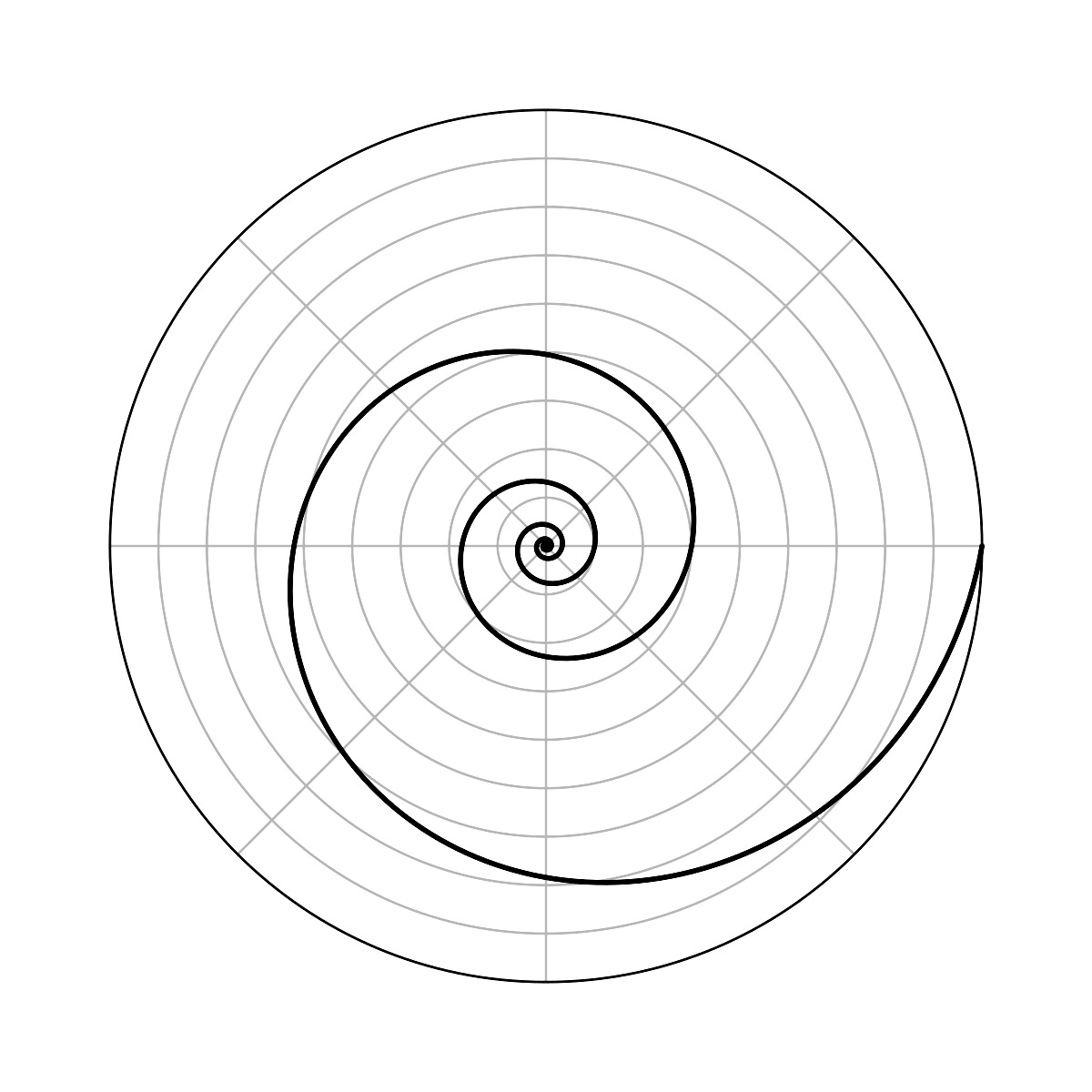
Practitioners are arriving from many directions at a similar insight: we belong to systems larger than ourselves, and so we cannot govern as if we stand outside them. One of the clearest maps of this is the familiar socio-ecological model. Spun on its axis, the concentric circles open into nested systems at every scale — each one whole in itself, each one entangled with the others.
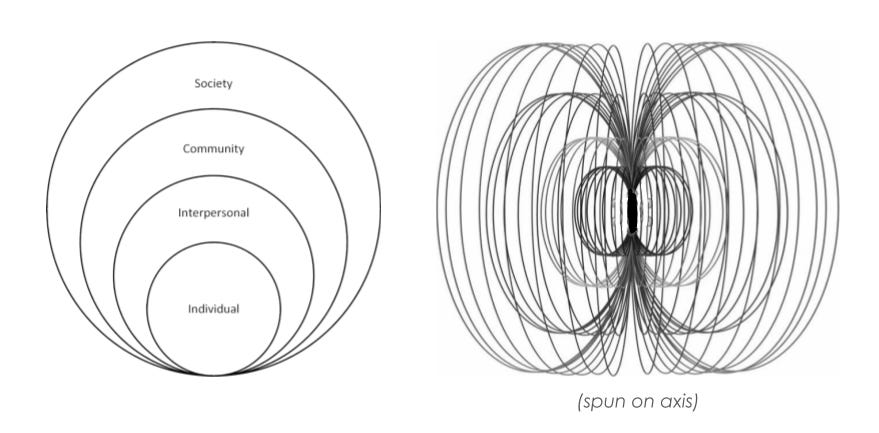
In the version on the right, the shape of each nested system is a torus — a continuous surface, no apex, no edges. Always in motion, always returning to center.
Karen O’Brien, in You Matter More Than You Think, draws similar nested circles, but reads them from the other side: the personal sphere — our beliefs, values, and worldviews — isn’t the small ring in the middle of things. It’s the outermost and most encompassing one, the most powerful place of leverage we have. The inner isn’t adjacent to systems change; it’s the medium the rest of it swims in.
On the torus there’s no contradiction in that — outermost and innermost are the same orienting depth, met from opposite sides of one continuous surface.
This is why the inner work can’t be adjacent to governance. Governing living systems isn’t the work of changing systems “out there.” It’s how we participate in systems we already belong to — which means the somatic and contemplative practices of awareness, presence, and self-regulation aren’t a supplement to governance. They’re inside it. And governance, properly understood, is the question of how we create the conditions for that kind of participation.
So here is the tension this post is named for. Even in networks where practitioners design the very governance they then live inside, the “outer” and the “inner” can sit strangely apart. Many of us learned to hold them as separate spheres, even subconsciously rank order them, and we go looking for bridges between them.
In the outer work, we recognize structural governance — distributed authority, recognized agency, the question of who is authorized to decide what. This is where nearly all the attention and tinkering goes. The inner work is the quieter thing: the personal navigation, the governance of the self, the felt sense of values, intuition, growth, and choice beneath all of it. How often does that get put into the governance framework or charter?
As Indy Johar notices, the structural version of governance falters on the terrain of complexity — it tries to authorize action in advance, but in a complex system, what’s needed can’t be fully known ahead of time. So it answers who is authorized to act, but not what orients the self that is now authorized. The standard answer is that the shared purpose orients us — but that is still outside-in, a direction handed to the self from beyond it. And so we are left, again, searching for a bridge: a way to integrate the inner more actively with the outer.
Here is a different move. Not a stronger bridge — the recognition that there was never a gap to cross.
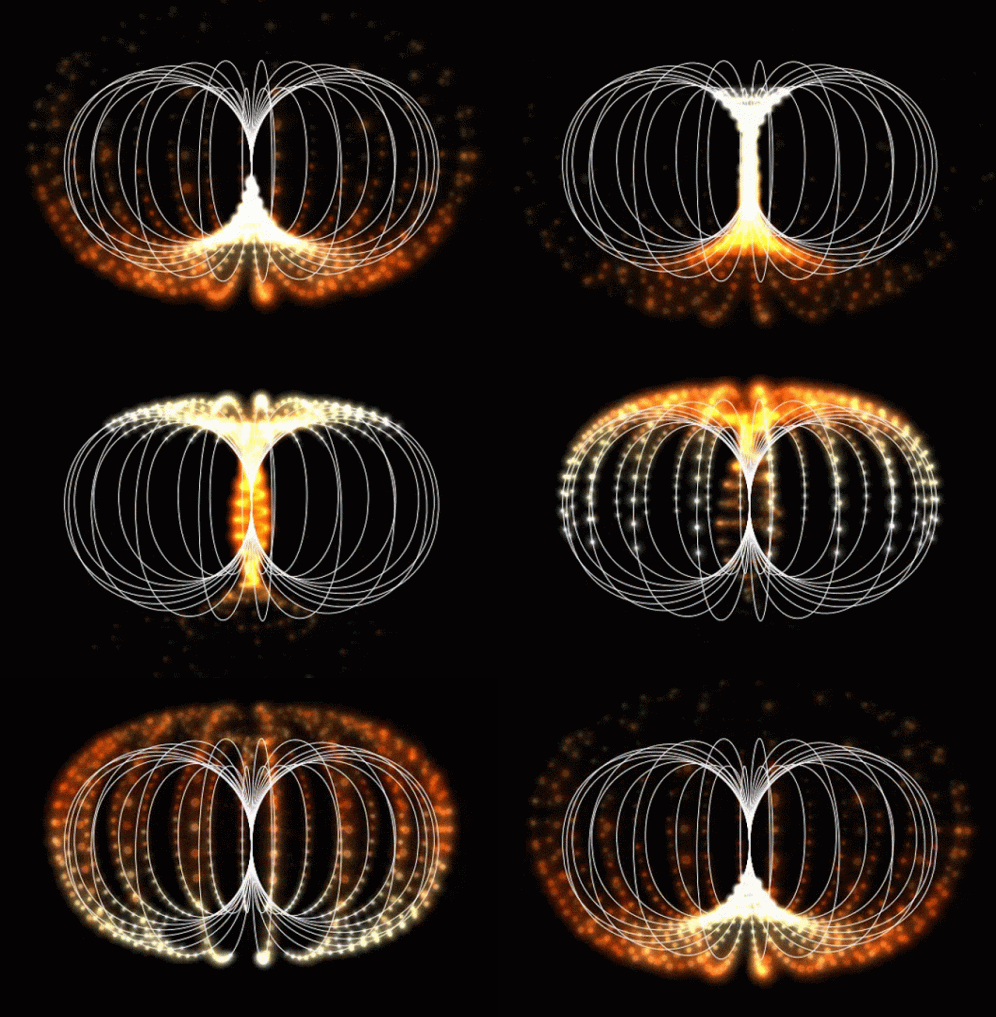
A torus is a single continuous flow with no permanent inside or outside. A current rises through the center, opens across the surface, flows down around the periphery, and returns through the center to rise again. What is inside in one moment is outside the next. So inner and outer are not two domains. They are two phases of one circulation. Center and periphery stay distinguishable — they don’t collapse into each other — but they breathe, in and out, as one motion.
The relief in this is not a more elegant integration of inner and outer work. It’s permission to set down the effort of building the bridge.
In my 20s, navigating my way into adult life, I came across a line from Frederick Buechner that became a kind of mantra: I am called to the place where my deep gladness and the world’s deep hunger meet. That single sentence became a compass for how I made career moves over the decades that followed. The criterion was always to serve both at once.
Buechner brings the inner and outer into a single breath. The meeting place isn’t a span between two domains; it’s one place that exists only because both gladness and hunger are present at once. Even now, the inner work I’ve had to do to put my ideas into the world isn’t separate from the sense that this is a calling I’m meant to step into. When I feel a calling, I assume it’s not something contained just in me. The world — something larger than myself — is doing the calling. Part of how I know it’s a genuine calling, and not something I “should” do, is that I feel an aliveness about it, so that even when it’s hard, it satisfies.
And this meeting-point isn’t a place you find and then stay. The systems move around and through me; the torus is what holds that circulation. I keep breathing between my gladness and the world’s hunger, and the work itself keeps changing as I do.
Holding the inner and outer in one flow is also what keeps me from dissolving into despair about the world’s hunger — easy to do these days — or exhausting myself trying to meet it. David Whyte, the poet and philosopher, tells a story about his own burnout working for a nonprofit. A friend, the poet-priest John O’Donohue, asked David whether he knew the antidote to exhaustion. The antidote to exhaustion isn’t rest, he said, it’s wholeheartedness. In the language of the torus, Whyte’s boundaries had gone too porous — the flow dissipating outward into the world’s hunger without returning on the in-breath of his own deep gladness.
The opposite can happen too. Sometimes people feel guilty for their own gladness while others are suffering — and that guilt can wall the gladness off, pooling it where it never flows back out to meet the hunger it was meant for. None of this is to diminish rest, which is a basic human need. It’s to notice the individualistic quality that words like wellness and well-being have taken on lately — the way they’ve drifted toward retreat, the in-breath without the out.
There’s a four-fold version of Buechner’s compass: Andrés Zuzunaga’s Purpose Venn diagram — what you love, what you do well, what the world needs, and what you can be paid for, meeting in the center as purpose. It offers a four-direction version of the same felt discernment: where I’m open or closed, what I’m collapsing toward or away from — like, all passion and no profession, or all vocation and no love.
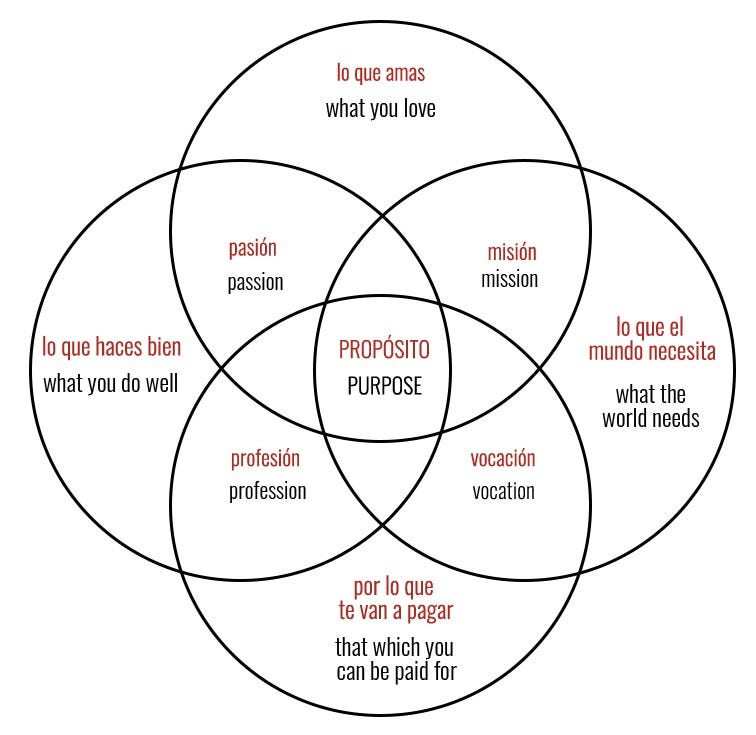
The way Zuzunaga came to the diagram is itself part of the point. On The Ikigai Podcast, he describes creating it — long before it was widely mistaken for ikigai — during a period of regular meditation and contemplation on purpose, reflecting on the questions his clients brought and on what natal charts revealed. Insights would simply arrive, from a source that felt like a mystery to him. One of them was the seed of the diagram. It came to him, not from him — sensed, the way these patterns tend to be, rather than constructed. Drawn flat, it tempts the eye to find the single spot where all four circles meet and stand there. But it was born as a living orientation, and the torus gives it back its motion: purpose isn’t a place I arrive at and hold. It’s an ongoing navigation among four pulls, the still center I keep orienting around while they move.
I want to be honest about where this gets harder, because resourcing the self can quietly become its own trap. There’s a version of “inner work” that never circulates — that pools in me, walls off, and justifies itself as health. The tell is the return path: does what I tend in myself flow back out to meet a need, or does it terminate in me? That’s the difference between a self that stays transparent — letting the flow pass through — and self-centeredness, a self bending everything toward itself. Self-transparent rather than self-centered: the center the system orients around isn’t me, it’s the purpose I’m in service to. Resourcing makes the circulation possible; it is not the end point.
Which brings me to autonomy: if we’re all breathing in one flow, what happens to sovereignty? Sovereignty and relationships are not opposites — they flow through each other in a deeper wholeness. Autonomy is the membrane’s capacity to close. And that capacity is exactly what makes opening safe rather than self-erasing. A self that cannot close cannot truly participate; it loses itself in whatever it’s near. The freedom to say no is what gives any yes its meaning. Or, as Toni Jones sings in her song No is Bae, “A dishonest yes is an honest no — to myself.“
This is not an abstract point. It’s one of the places our inherited governance fails us most concretely. Coercive hierarchies don’t just concentrate authority; they teach us that objection is costly and dissent unsafe. Many of us, in different ways, have learned to keep our real reservations quiet. So people arrive in network spaces — spaces that ask for genuine co-creation — without the felt safety to bring their full agency, in whatever form it takes for them: floating a proposal, asking for help, or knowing when they are authentically not in consent and saying so. You can’t simply declare a network non-hierarchical and expect that safety to appear. It has to be woven through trust, because the opening is only real if the closing was genuinely available.
A friend of mine has a finely tuned detector for when it isn’t. His vocation puts him in a corporate hierarchy with a private equity firm at the helm. He bristles at slogans like “teamwork makes the dream work” — not because he doesn’t love a real team, he does, but because he can feel when belonging is being extolled from outside the room by someone who quietly collects the return. That reaction is accurate. It’s a boundary doing its job, refusing to let his gladness be conscripted into someone else’s accumulation.
And he shows me the limits of inner work, too. He can be rested, resourced, boundaried, entirely self-transparent — and still spend his working day inside a hierarchy where the decisions arrive from above and there’s nowhere for his intelligent sensing to go. The flow is blocked there, and not by any failure in him. A pyramid is a torus with its return path cut. The flow runs upward and never returns. No amount of inner work completes a circulation the structure won’t allow.
Which is the whole point, and why the inner and the structural were never separable. Agency — the freedom to act on how one is genuinely called to act — isn’t a personal luxury layered on top of governance. It’s a structural requirement of governance designed for regeneration. This is a real transformation of what most of us have meant by the word: not authority distributed from the top of a sound structure, but the return path built in from the start, so that what people sense can actually move and shape their own participation and the whole.
The consent principle is one of the mechanisms that keeps that path open — grounded in respect for both autonomy and belonging. It’s the meeting point of the two, just as a healthy membrane must be able to open and close. The principle is plain and exacting: I can’t truly say yes if I’m not free to say no. A flow I’m not free to refuse isn’t circulation; it’s a pump. But a refusal that doesn’t consider its impact on others isn’t consent either — it’s self-centeredness posturing as sovereignty.
Authentic self-governance can never be commanded from outside. The moment it’s required for someone else’s gain, the sovereignty it depends on is already being violated. Nothing about us without us.
So what finally orients me is not myself. It’s a pull I can feel and can’t possess — the sense of being called because something is calling. I’m not trying to integrate my inner and outer work. I’m listening from my own resourced self to where the inner and outer are already seamless — between gladness and hunger, between holding and opening. You matter more than you think, as O’Brien puts it: not because you act on the system from outside it, but because you are one of the places the system breathes.
The same orienting pull operates at every scale, named differently as we go — mystery at the personal scale, shared purpose at the group and network scale — but it’s the same gravity. And the same movement — the breathing between giving and receiving, the self that stays whole by staying in flow — is the seed of the next scale, where groups and networks and networks of networks are governed by the same shape.
I suspect I will read this several times to fully digest the richness.
I love the torus metaphor and the animated gif you share. Thank you!
I love this❣️
This is how I see and experience the (relational) field.
I was just talking about this in my Substack Live yesterday.